
What if your best LinkedIn content is hiding in conversations you're already having?
On this episode of Ponderings from the Perch, the Little Bird Marketing podcast, host and CEO Priscilla McKinney discusses a systematic content marketing strategy for creating high-quality LinkedIn posts without adding another full-time job to your plate. She reveals how to capture moments of unconscious competence—when you're speaking from deep expertise during client pitches, presentations, or team meetings—and transform those insights into a consistent content library.
She explains that the most powerful content doesn't come from staring at a blank page at 7 a.m. with coffee in hand. It comes from recording those golden moments when you're in flow, solving real problems, and naturally articulating your unique value. "Workflows [only] work when they fit YOUR work flow," McKinney explains. "Don't try to do something that is so foreign to you that you will not do it. Get inspired to understand how you can get disparate systems to work together and shorten your path to success." By building an automated workflow using tools like Zapier, ChatGPT, and Claude, you can capture transcripts, filter for viral-worthy topics, and create polished posts that actually sound like you.
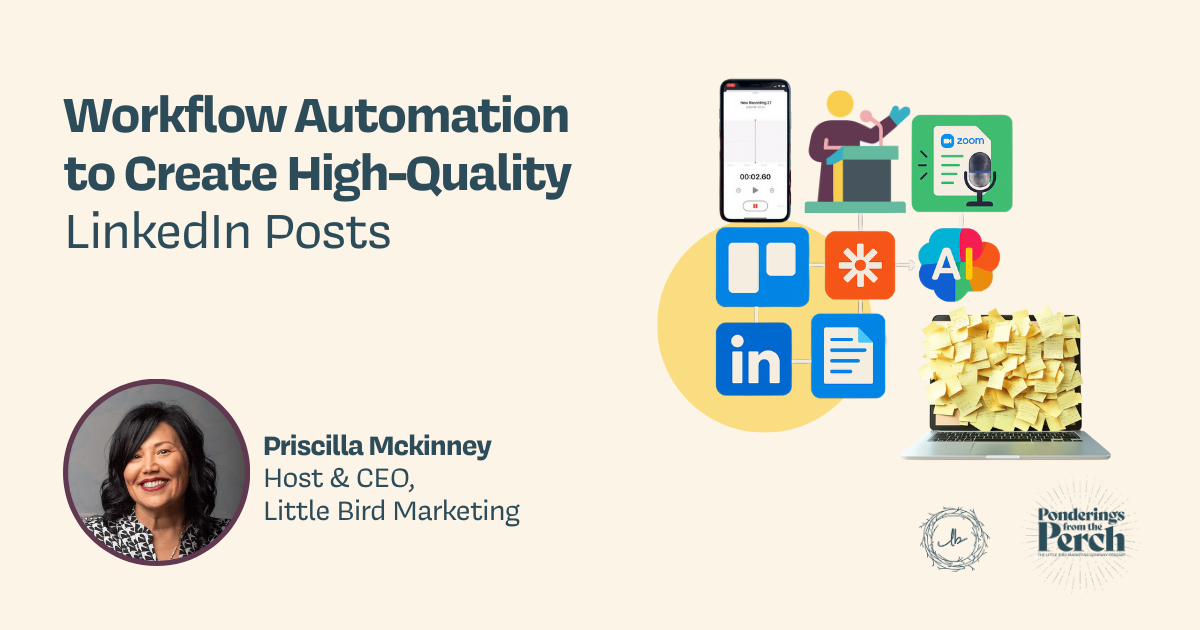
The episode walks through a six-step automation process: capturing transcripts from recordings, using Zapier to connect tools, filtering topics with ChatGPT aligned with your b2b buyer persona, crafting spicy takes with Claude, creating project management cards, and scheduling polished posts. Priscilla emphasizes that perfection isn't the goal—adaptation is. Your tech stack and team structure will differ, but the principle remains: multiply the value of work you're already doing by being kind to your future self.
Music written and performed by Leighton Cordell.
Sponsors:
Priscilla McKinney here! I am very excited to tell you about my book:
The book's chapters are designed to be time-efficient, ensuring busy professionals can easily integrate these transformative ideas into their workflow. From discussing the state of affairs in business to providing fundamental strategies and seven practical anchors for staying on course, this book offers a fresh perspective and a competitive advantage in today's complex business landscape. Visit priscillamckinney.com for more information.
Ever feel like your marketing plan is just... meh? You've got the pieces, but are they really working together?
We often find that even when companies are doing the right things, they may not be doing them in the right order. The results are, well, no results. Curious how you can effectively evaluate your marketing efforts? Want clarity on your next best strategic move?
Take our Marketing Assessment Quiz and in just minutes, discover exactly where you stand – and where you could be going.
Click here and take the quiz today and don’t leave success to chance.
Priscilla McKinney: Hello and welcome to Ponderings from the Perch, the Little Bird Marketing Company podcast. I am Priscilla McKinney, Mama Bird and CEO here at Little Bird Marketing. I am so excited about our topic today. Today we are talking about something that is going to change how you think about creating very high quality LinkedIn content. So imagine this, it won't be very hard for you to imagine.
You're in the middle of a client pitch. absolutely crushing it. You're in the zone. You're articulating your unique value position in a way that just seems to be flowing naturally. And someone asks you a challenging question and you deliver this brilliant answer that perfectly encapsulates what makes your approach different.
And you're thinking in your mind, man, I should write a post about that.
Priscilla McKinney: So for me, I often find myself on a stage and what happens in that next 40 minutes comes from me talking about a topic where I'm a true subject matter expert and I feel it happening. The magic is going, I'm firing. It's like I can see from the crowd that it's resonating because I'm speaking fluidly and powerfully. And when you see that resonance in the room, think, ooh. should make a LinkedIn post about that.
And don't you want to tap into both of those things for amazing LinkedIn posts, not things that are like, now I am writing some marketing ease, right? In fact, I even talk with other leaders a lot of times at conferences and they finish talking from the stage and they tell me, yeah, I'm gonna take these key points and I'm gonna post them on social media and get a longer tail return on investment for this time that I spent creating this amazing piece of content. Spoiler alert, most of them don't. Because by tomorrow morning, when they sit down to write that LinkedIn post, they're staring at a blank page with absolutely no real significant memory of that golden moment.
It's like they can't go back and recapture what happened. And I'll admit that I no longer start talking on a stage without pressing record on my phone. I just don't. But let's say you start doing that and you capture some great stuff. What are you going to do with it?
And more importantly, how are you going to do what you're going to do with it? Like, how's it going to happen? What's realistic? And that's what I'm going to talk about today. How to capture those moments of unconscious competence when you're speaking from deep expertise and how you can actually turn those into a library of high quality LinkedIn posts that are teed up and ready to go.
And we're talking about building a system that captures you at your best and transforms those insights into consistent content without adding another thing to your full-time job and to your very crowded place. So let me get real with you about my situation. Now, I'm a selling president. I manage my own LinkedIn account and I have almost 20,000 followers. And they follow me because they want to hear from me.
They want to know something about my expertise, my perspective, my frameworks. And I have earned a reputation for operating under the mindset of always be helping. In fact, I created that hashtag, hashtag always be helping. Feel free to use it. But every piece of content I create, I sit and think about what challenges my most ideal client is facing.
And I want to talk coherently about those challenges and offer quick wins, ideas, mindset shifts, and even specific frameworks for setting up long-term strategies for success. So it's like from the short term to the long term, everything in between. But here's the brutal truth. Creating consistent LinkedIn content is where almost all founders stall. And I can fall into that as well, but I have found a way to make things work for me in a more efficient manner and I'm going to share that with you because my days are tight, so are yours.
You have back-to-back calls just like I do. You have client work, have team management, you have strategic planning. Love me some strategic planning. And somewhere in there, you're supposed to craft thoughtful LinkedIn posts that showcase your expertise and provide genuine value. We all ab- We all would love to do one thing at a time, to focus, to do deep work, but efficiency doesn't come from singular focus at every task.
It comes from multiplying the value of things you're already doing and moving them together in the right way. So think about it this way. When are you at your absolute best? For me, like I mentioned, it's when I'm on stage, you're delivering a keynote. But I know that you also are often your best when you are pitching a meeting.
But let me start that phrase again.
Priscilla McKinney: So ask yourself, when are you at your absolute best? It might be on a stage delivering a keynote. It might be during a client pitch meeting. It could be in an interdepartmental meeting when you're presenting what you really did on a particular project. And let me see.
Priscilla McKinney: Ask yourself when... no, start that over. You need to ask yourself.
Priscilla McKinney: You need to ask yourself, when am I my absolute best? It could be when you're on stage delivering, but it could be in a client pitch meeting. It could be in an interdepartmental meeting. Whatever that moment is, you need to become awake and alive about, catching it like this is me starting to get in the zone. In those moments, something magical is happening.
You're getting into that flow and your deep expertise is just pouring out. And the words are coming easily to you because in that moment, you're not actually trying to create content. You're just being yourself. You're solving problems and you're sharing what you know. And that is a completely different experience from sitting down at 7 a.m. with a cup of coffee, staring at that blank LinkedIn text box, trying to conjure up some magic or something brilliant from thin air.
Right? You need a draft. I hate staring at that blank page. And so RIP.
Priscilla McKinney: Okay, so get rid of that last part, I need a draft. Okay, move to the next section.
Here's my not so secret weapon.
Priscilla McKinney: Now take that out.
Priscilla McKinney: Here's my not so secret weapon. I've already explained to you. I don't get on a stage without pressing record on that voice memo app on my phone. I have like 1500 voice memos in there. And yes, your phone is basically a $1500 recording device.
It just happens to make calls sometimes, right? So you want to figure out when that moment is happening for you and get it recorded. Now, we also all know that almost all of our meetings that we're having are being recorded. You already have transcripts after transcripts. And so whether you're on Zoom or you're on Teams or you're on Google Meets, wherever you're recording this stuff, you want to think about how to access those golden moments, those perfect articulations of complex ideas.
Now, I'm not saying everything in that recording or in that transcript is going to be amazing, but sometimes there's just magic that happens. Okay, so become awake and alive to that. Understand what calls you've had or what meetings you've had that are on specific topics that you think would be meaningful to your audience. And let those topics become drafts and let those drafts land neatly into your project management system. And then you can start posting daily or three times a week on LinkedIn.
And it's not so much effort. It doesn't become a second full-time job, right? So let me walk you through the specifics. Now.
Priscilla McKinney: You're gonna need to adapt this workflow, I suggest, to your specific tech stack and to your team structure. But the beauty of this approach is that you can customize it for your own situation. So step one, no matter what, is to capture that transcript.
God, okay, let me start that section again.
Priscilla McKinney: Now, of course, you're going to have to adapt this workflow to your tech stack and to your team structure. But the beauty of this approach is I hope to inspire you to customize it for your own situation. But no matter what you do, you're going to have to start with step one. You're going to have to capture that transcript. So if you have an iPhone, I'm just telling you right now, they've improved that voice memo.
You can literally copy the transcript and email it to yourself. Just saying. So I use Zoom and Riverside for recordings every once in at Google Meet if it's internal, but both of those automatically generate transcripts. And you might use Fathom, Otter, or any other kind of transcript sources, whatever. The key is that you're getting a text version of your spoken brilliance.
Step two, enter Zapier, the great instigator. I consider Zapier that great instigator because it helps me dodge that redundant and stupid chore. Zapier is what connects all of these disparate tools together. And here's what triggers my workflow. Zoom finishes a meeting or Riverside completes a recording and any transcript source I'm using then can trigger Zapier to grab that transcript and send it over to my Chat GPT.
Now step three is using Chat GPT to extract and to filter topics. It's really pretty good at this. And I like using different AI systems and LLMs for things that it's really good at. So in my opinion, ChatGPT is the thing I choose to run two prompts in the sequence. First, I get it to scan the transcript for unique insights and answers I gave that could make perfect post material.
It identifies topics that would resonate with my most ideal client personas. And I have a snippet so that I can tell chat GBT what those topics are and what questions they're asking and make sure that it is scanning that document for something that is not something necessarily I want to talk about, but things that are of value to my most ideal client. Then chat GBT takes that raw list and narrows it down to maybe three ideas or so of the most viral potential for LinkedIn.
Priscilla McKinney: Now, not everything you say needs to become opposed. That's not what I'm saying. So don't dismiss me on that. And that is why this filtering step is crucial. You might look at the three it offers and say, only two of these really make sense.
And that's, of course, like the critical thinking that humans provide when using large language models. It's just super important. Now step four is I think a little bit of where I make some magic because I have Claude trained in a very deep way on my tone of voice, my unique value proposition on all the services that Little Bird Marketing offers on my ideal client persona, all of the questions they've been asking, challenges they're facing, keywords I want to use. I mean, just everything. I have a massive paid account on there that is totally dialed into my unique value, right?
So once those filtered topics are identified Zapier can ship each one to quad along with the original transcript with So once chat GPT Filters those topics and they're identified Zapier ships each one to quad Along with the original transcript and this is where the raw ideas really start getting good I use what I call the make it spicy prompt. Claude takes each idea and rewrites it as a short or medium assertive take, folding in any lived experience or data that's mentioned in the transcript. Now, as I said, I have Claude programmed also for many, many episodes of where I've spoken in my podcasts or in my keynotes of other examples I've used.
And so it's going to do a better job really grabbing that lived experience from my expertise. But the result is a few sentences or a spicy take that actually sounds like something I would say. And if you want a little bit of more information about really the importance of a tone of voice or how to actually write that up, then go see my podcast about the importance of tone of voice and why you need that kind of a brand Bible, right? And I'll go ahead and put that link also in the show notes.
Priscilla McKinney: But even with AI in the loop, a distinctive point of view is what makes or breaks your post. And so you need Claude to be able to draw from your expertise and your voice. Because without it, you are really just adding to the LinkedIn noise. And that spicy take gives you that hook. It helps you get a compelling angle that makes people stop doom scrolling.
Okay, so step five is where I create the Google Doc and in my case a Trello card. All right, now this is where a web hook comes in and this is where the magic of automation really shines. Now, if you don't know what a web hook is, just go put it into one of the AI LLMs and ask it. So there's no reason to be, you know, in the dark anymore about these things. Don't know something, you don't have to wait for the next cocktail party to pull me aside and ask, just ask GPT, right?
Priscilla McKinney: Okay, I'm gonna start that part again.
Priscilla McKinney: So step five is where you create the Google Doc and Trello card. Now that's according to my tech stack. So whatever it is that you need to do. But this is where a web hook comes in. And it's really where the magic of automation shines.
Now, if you don't know what a web hook is, there's no excuse. Just go to an AI model and ask it. There's no reason to be in the dark about these things or feel dumb not knowing them. Don't worry about it. Just go ask ChatGPT what that is.
And if you need step-by-step instructions, just ask, right? You don't need to wait for the next cocktail party to pull me aside and whisper in my ear that you don't know what that means, right? So that webhook does two things simultaneously for me. First, it creates a Google Doc with all of the spicy take ideas. And it becomes the doc that I can use in order to really polish it up, right?
But I don't have to do the step of bringing it from one place to another place. I don't walk around the whole process. You know, I can get it somewhere where I can review it and I can see what's been captured and I can track my ideas even over time. Right. So next, I get it in the same webhook to create a Trello card for me.
If you're on Monday or if you're on ClickUp or whatever project management system you're using, this is what you would insert here. Now that project management card for me contains the Google Doc link to those spicy takes. And it is all from that source meeting that it came from. And it has all of the tags that I need because I can tell it who to tag on my team. Right?
So you might ask me, why would you want to add people to these cards? I thought you're trying to keep it simple. But for me, I add my graphic designer or I might add my videographer.
Priscilla McKinney: They can take a look at the document and help me think about each post and how it could be better or more visual. Now they don't need to weigh in on all of these things and we have a workflow that works for us because you don't want to be overwhelming in this moment, but they can identify a few of the hot takes that are worth a little extra lift. Maybe one spicy take would work better as a carousel or maybe another would be perfect with a short video clip. and maybe one needs a custom graphic, but my team can flag those opportunities and assign themselves to the posts where they can add the most value, right? So step six is where you actually polish them and schedule.
So once the team sharpens the copy and any graphics that are created, the post can move into your scheduling system. For me, that's HubSpot. For some of my clients, it's HubSpot, but some of them use other systems. So I can schedule these LinkedIn posts in advance and track their performance. You could use native LinkedIn for scheduling.
You could use Buffer, Hootsuite, whatever tool floats your boat. But the key is that you're not scrambling every morning to figure out what to post. You have a library of content that came from your best moments, polished by your team, and ready to go.
Priscilla McKinney: Okay, deep breath. Now I know you're thinking Priscilla, this all sounds great, but my tech stack is different. I don't use Trello. I don't have a graphic designer on my team. I mean, there's going to be some complaint here, right?
Stop. Do not worry about perfect. Adapt it. There's no way I nailed exactly your workflow. So feel free to use my workflow as I've described it, or just pull out the parts that help you become more efficient.
I think the limit to all of these tools is the limit that's in our own brain. We always think, I've always done it this way. That is the death to efficiency and to ultimate profitability. And P.S. Priscilla McKinney is not a nonprofit entity.
I am here to make money. I am not ashamed of that. In order to make money and to stay relevant in today's world, I need to do these things quicker. Now, everyone's posting cadence is different.
Priscilla McKinney: and everyone's tech stack is different and everyone's team structure is different. So get over that idea that it's gonna work perfectly for everyone straight out of the box. But I hope I've inspired you and given you an idea of what is possible and what you could set up if you take the time upfront to get things planned. Yes, it is tedious at the beginning. Setting up Zapier workflows, testing the prompts, making sure the webhook is hitting the right endpoints, it takes time.
I remember Leighton and I working over and over on one about why it was not adding the right keywords to the Trello guard, and it was aggravating, but we figured it out. And here's what we often say at Little Bird Marketing, be kind to your future self, right? This workflow is the exact example of that mindset. You're doing the hard work now so that three months from now, six months from now, a year from now, you have a consistent stream of high quality content that requires minimal effort to maintain. You're capturing your best thinking automatically.
You're multiplying the value of every client call, every presentation, every conversation. Workflows work when they fit your workflow. Okay. That emphasis is intentional. Let me say that again workflows work when they fit your work flow Do not try and do something that is so foreign to you that you will not do it.
Get inspired to understand how you can get disparate systems to work together and shorten your path to success. Okay. Maybe you just glossed over what I just said there, but it is really important. So I'm going to kind of interrupt this podcast to tell you about a mindset shift.
Priscilla McKinney: that really helped me understand a great foundational truth. My husband and I have been talking about our next era of life, right? We're about ready to be empty nesters and we want to be mindful about taking care of ourselves in a way that gives us a full life just as we're getting more free time. I'm in my fifties and I need to lift weights. But we were listening to a podcast and the expert was asked, what's the best workout at this age?
And the expert said, oh, that's a good question. And the answer is, the one that you're going to do.
Priscilla McKinney: So yes, you might be asking which tech is the best, what workflow is the best? Well, my answer is the workflow that is the best for you is the one that you are going to use. So make something that makes sense for you. Okay, a few final thoughts before we wrap up. When you are stuck setting this up and you will get stuck, we all do, just ask AI to fix it for you or help you rework it, help you rethink it.
What are you missing? What would we better? What did Priscilla not know? What did she miss? Chat GPT can give you specific instructions for different systems.
And Claude can help you debug webhook payloads. Like that has been really key for us. The AI tools that you're creating for your content can also help you build the system that creates the content. And when it's wrong, and it will be wrong sometimes, do not give up.
Priscilla McKinney: Iteration is the part of the process. The first version of any automation is never perfect. I know this, right? You need to refine your prompts. You'll adjust the filtering criteria.
You'll tweak the team assignments. Gosh, you're going to actually have to put a comma in a particular place on a webhook, right? But if you do it and stick with it, the compounding returns are incredible. So.
Priscilla McKinney: I hope this inspires you to create a workflow that captures your unconscious competence and turns them into consistent content pieces. I would love it if you would share your wins with me on LinkedIn. I want to see what you build. And remember, the best content you'll ever create isn't written at a desk staring at a blank page. It's spoken in moments when you're in the flow, solving real problems for real people.
Your job is to get somebody else to capture it and do it for you. So from all the peeps here at Little Bird Marketing, have a great day and happy marketing.

Let Us Know What You Thought about this Post.
Put your Comment Below.