
Your best LinkedIn content already exists in conversations you're having every day.
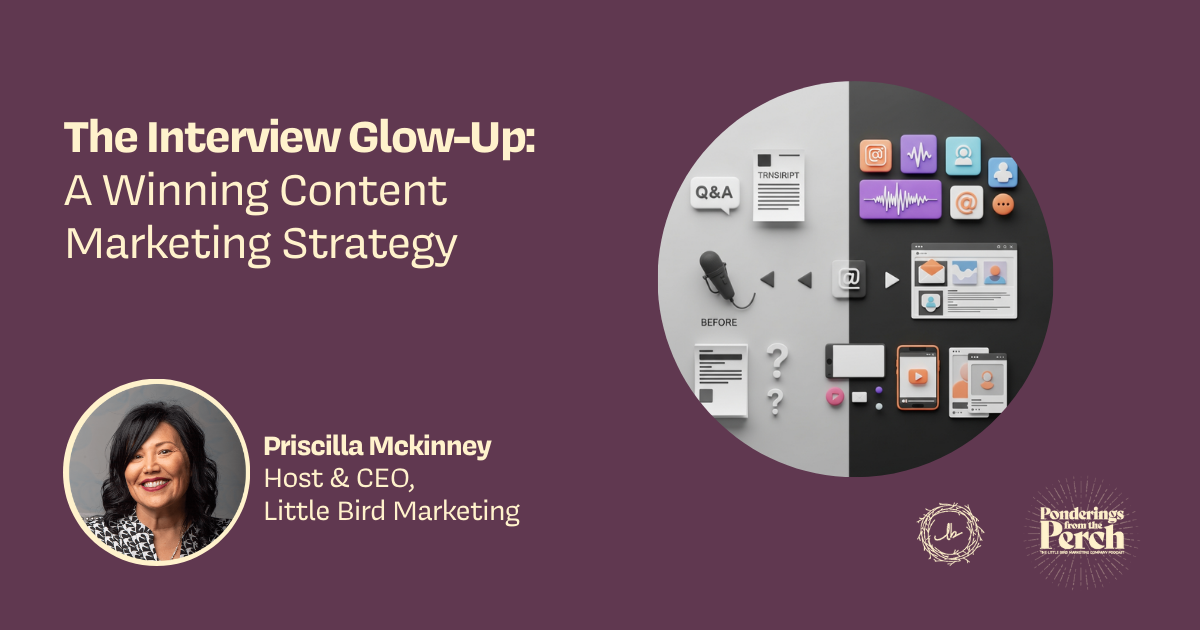
On this episode of Ponderings from the Perch, the Little Bird Marketing podcast, host and CEO Priscilla McKinney reveals how strategic interviews transform the content creation problem from manufactured brilliance into curated snippets of conversations. She walks through a content marketing strategy that turns industry leaders, colleagues, and conference contacts into sources of compelling material while building genuine professional relationships.
Before any tips are handed out a strong warning is given that the approach requires understanding your audience first through persona development. With that settled, asking questions that are relevant to your ideal audience becomes easy!
But how do you get the best answers from experts you’re already talking to? By asking better questions! She explains that most professionals fail at interview content because they ask questions that trigger autopilot responses. Generic queries about leadership style or company background produce forgettable answers because the subject isn't actually thinking. Better questions dig into specific decisions, failures, trade-offs, and frameworks that force people to explore their reasoning rather than repeat rehearsed talking points. This distinction separates content that stops the scroll from content that gets ignored.
"When someone has to actually think about an answer to your question, the answer starts becoming interesting," McKinney explains. "In those stories they might even share a framework, or if they start talking about how they frame something up, say whoa whoa whoa whoa tell me about the framework!” Encouraging others to reveal their thinking process creates really interesting content that stops the scrolling on LinkedIn."
Interviews solve multiple problems simultaneously. When you interview someone thoughtfully, you're not just extracting content; you're giving them visibility, building a genuine relationship, and positioning yourself as someone who curates valuable insights for your network. A three-minute recorded conversation at a conference becomes weeks of LinkedIn posts. A colleague's solved problem becomes a framework your audience can apply. The interview itself becomes the relationship builder, not just the content source. This approach works because it removes the pressure to be brilliant and replaces it with genuine curiosity about what smart people know.
Mischief managed.
Music written and performed by Leighton Cordell.
Sponsors:
Is your concept testing budget disappearing without driving better decisions?
Most insights teams waste 30 to 40 percent of their research spend on preventable leaks. Socratic Technologies has created a free audit to help you identify what leak is costing you the most—and exactly how to fix it.
Click here to download the audit today and start making concept testing that drives growth.
Priscilla McKinney is not just a CEO; she is also a LinkedIn Influencer. The reality is that very few people are using LinkedIn efficiently or effectively, and if you’re not careful, social media can become a black hole. When you emerge, you find you wound up in a place you never intended to go and you’re wondering where all the time went.
Time is precious, and trying to be everything to everyone means becoming nothing to no one. That's why she's developed a transformative 12-week course that goes beyond basic tips and tricks – teaching you how to build a strategic network and create stellar content that cuts through the LinkedIn noise.
Click here to learn more, and sign up for a spot in her social influence course today!
Priscilla McKinney: Hello and welcome to Ponderings from the Perch, the Little Bird Marketing Company podcast. I'm Priscilla McKinney, mama bird here at Little Bird Marketing, and today we are solving one of the most common problems I hear about. As a content marketing strategist, what I hear from professionals trying to build their presence on LinkedIn is that they don't have a consistent way to source great content. You're staring at a blank screen, your cursor is blinking at you.
You know you need to post something on LinkedIn. You need to build a presence. You need to demonstrate expertise. And you need to stay visible to your network. But what should you write about? Where do you even start?
Now, if you've listened to anything of the past 475 plus episodes of this podcast, you'll know that I'll say you shouldn't write anything until you have your most ideal client buyer in mind. Write for your audience.
And PS if you want an easy way to start that journey just head over now to littlebirdmarketing.com resources and snag your own persona template to use. But if you've already done that work you still need a content marketing strategy that wins the day.
As always on this podcast, I'm going to pull back the curtain and show you what the pros know and today is no different. So here's a solution that's hiding in plain sight maybe you haven't considered. Instead of trying to manufacture content from thin air, go interview someone.
Interview an industry leader, interview a co-worker, interview someone you meet at a conference. Turn that conversation into compelling LinkedIn content that showcases your expertise and builds your network.
Most people think interviews are just Q &A sessions that produce boring, generic content. And I hope you don't ever think that because you're a listener of this podcast and I do amazing interviews with amazing people. But that is only going to miss the mark if you're asking boring, generic questions. When you know how to conduct an interview that draws out real insights, stories, and expertise, now you've got LinkedIn Gold, right?
I'm going to give you some tips about how to give your interview a glow up and how to ask better questions that will produce juicy, compelling answers and how to turn simple conversations into content that people actually want to read. So just take a deep breath. This is not about becoming a journalist and adding to your long list of things to do. This is about having strategic conversations that solve your content problem while you build valuable relationships.
Okay, so you're probably wondering how is it that interviews can solve my content problem, right? But you know that creating consistent LinkedIn content is exhausting.
You know you're supposed to demonstrate expertise. You're supposed to be sharing insights, providing value, and do it all while not sounding too salesy and being totally authentic, right? And that's a lot of pressure when you stare at that blank screen. But the beautiful thing about interviews is it takes that pressure off. It's not you that needs to be brilliant.
Your job isn't to have all the answers. Your job is to ask good questions of very, very smart people and let someone else share their expertise.
Expertise that you can think about and you can share their thoughts and give them credit for it, but make it be in a situation where it's compelling and it's connected, right? And you instead become the facilitator of valuable content and there's no more pressure to be the sole creator, right? So this approach works for three big reasons. First, interviews naturally generate authentic content, right? You've taken the pressure off of people.
You're capturing real conversations with real people and they can just speak from their actual expertise. That authenticity often comes through in a way that manufactured content never produces. People can tell when you're having a genuine conversation versus when you're trying too hard to sound smart and get the post just right. Yeah?
Second, interviews give you access to expertise beyond your own, right? It's like, yeah, I'm so smart, but I'm even more smart because I hang out with a lot of very, very smart people, right? So it's about really tapping into that network because maybe you are great at what you do, but you're not an expert in every adjacent topic that your LinkedIn audience cares about. And interviews let you tap into other people's knowledge while still building your own thought leadership. In this way, you're curating valuable insights and making connections that your audience might not find on their own, right?
Third, interviews build relationships while building content. This is one of my fun things I love about my podcast is that while it costs me to make it I love what I get back because I am getting a channel to talk about my expertise. But I'm in that moment actually building a relationship with somebody and that relationship often pays off for me way down the line.
So when you interview someone thoughtfully, you're not just extracting value from them, you're giving them a platform and you're highlighting their expertise, but you are eventually creating something that benefits both of you. You know how much I like a good collab, right? But that person then becomes a part of your network in a really meaningful way.
So you don't need to launch a podcast to become a professional interviewer to use this strategy, I promise you. Once you start looking, you are going to see the interview opportunities everywhere. Industry leaders and experts are people in your field who love sharing their experience, their perspective, and their insights, and their thoughts, and their predictions that your audience wants to hear.
Maybe you've heard that they've solved a problem you've been struggling with and that's a beautiful way to start because you don't have the answer and you're asking someone else their opinion and you're asking them for advice. Maybe you could ask someone to take a contrarian view on industry trends. Maybe they've been doing their work for decades and they have seen patterns that they could share. And here's the thing, reaching out to interview someone is actually flattering and most people say yes this is maybe an overlooked fact about podcasts when I ask someone very important to be on it their answer is almost always yes.
You're asking them to talk about their area of expertise which people love to do people love to talk about themselves and a simple LinkedIn message you can send is I'd love to interview you about XYZ for my LinkedIn audience. It opens up so many doors more than you could even imagine.
Your company is also full of coworkers and colleagues with expertise worth sharing. I mean, come on, how easy is that to ask someone you work with to help you out and accept this interview? The engineer who solved a tricky technical problem a couple months ago, or the sales director who turned around a struggling territory. Maybe there's a customer service rep who handled a difficult situation with grace, or you fill in the blank. You have these experiences.
Look around you. These people have insights and experiences that your audience wants to hear. Internal interviews really serve multiple purposes. You get content for your LinkedIn posts that demonstrate your whole company's expertise.
Your colleague gets internal interviews serve multiple purposes and they really get overlooked. But look at this. You get content for your LinkedIn posts that demonstrate your entire company's expertise. Your colleague gets visibility and recognition. And if the content is valuable enough, it might even make its way over to the company blog. Who knows?
But even if it stays on your personal LinkedIn, you're building your professional brand while highlighting internal talent. Also, another goldmine is conferences and they get so overlooked. Oh my goodness. People waste that opportunity so much. You collect business cards, you have surface-level conversations, and you promise you'll stay in touch, but then so few people actually do.
What if instead you showed up at conferences with a simple content strategy? What if you interviewed people? What if you asked if you could record a quick three-minute conversation about a challenge they had or a very interesting project they just finished? Suddenly, you're having a much deeper conversation and you're creating a real connection. And also, you're walking away with LinkedIn content that you could use for weeks, right?
So I love how our event planning services help clients build strategic conference plans that maximize this ROI, including interviewing people at conferences. It's about including content marketing strategies around conference attendance. And I would love to talk with you about how we could help you. That's not exactly what this podcast is about, but of course, go to littlebirdmarketing.com and you can go to slash event hyphen planning if you want to see what we do.
But let's keep pressing on. Let me give you what the pros know about interviews. Okay, so let's talk a little bit about what you shouldn't do because the quality of your interview depends entirely on the quality of your question. So don't just show up and think you're gonna wing it it's gonna be awesome. Dull answers come from dull questions, right?
So think a little bit about how to get someone to say something unpredictable. Like for example, if you ask someone, do you think about AI? Oh my gosh, nobody wants to hear that. It's gonna be a generic rant, right? Don't ask things like, tell me about your company, tell me about what you do, how did you get started? These questions just produce predictable, forgettable answers.
Your subject goes into autopilot mode and they give you the same elevator pitch they just literally gave to someone else, right? In fact, they've given it a hundred times. So get away from those generic questions.
Because they don't require anyone to do any real thinking. The person you're interviewing needs to dig into some of their experience or perspective. They don't need to be reciting information. That's not content. That's a press release. Good questions make people think, and they make people think about specific things.
They might help someone explore decisions that are trade-offs, that are difficult or maybe complicated. I want to know where people failed. Like what did that feel like and what did they learn from it? Great questions dig into reasoning behind choices and not just the outcomes.
So when someone has to actually think about an answer to your question, the answer starts becoming interesting. And because you're not recording a podcast, you're just recording a little interview to use later, they can take as long as they want, right? In fact, encourage them to tell a story.
Those stories they might even share a framework or if they start talking about how they frame something up say whoa whoa whoa whoa tell me about the framework right help them reveal their thinking process that's really interesting that kind of thing is content that stops the scrolling on linkedin right so in short better questions of course make better content but what kind of questions could you ask?
So for example, instead of what's your leadership style? Maybe ask, tell me about a time you had to make an unpopular decision with your team. What happened? How did you say it? What did the conversation sound like? Right?
So that's what I mean by getting specific and asking about stories. Like I said, ask about failures, ask about lessons, ask about those trade-offs, ask about those frameworks, right? I love talking about mental models. You can listen to a few podcasts I've done about mental models I love.
And I'll actually put them in the show notes here, but those mental models have really good juicy tidbits and juicy ways that you can frame up amazing questions. The last thing I want to say about the questions is that you want to challenge assumptions. You might even start a question by saying, everyone says X but you do Y.
Okay, tell me about that. So you have to observe people and you have to know something about the person you're interviewing, but you might want to call out that kind of difference maker that this person is. Maybe you want to say, you know, a lot of people say this about AI, but what do you think people are missing? That's a good question. What is it everybody else is missing? And just know that contrarian perspectives make compelling content because they make people stop and think differently.
Okay, so let me give you a few practical tips for your first interview because it's going to be a success. It's going to be wonderful. So please think about getting rid of that worry that you've never conducted an interview before. And I'm going to be hard pressed for anybody in market research that listens to this or in marketing to tell me that they have not done a serious interview. But if you've not done it just for content purposes, it might feel a little funny at the beginning.
So if that's the case, don't worry. All you need to do is start simple.
So don't get any fancy equipment or get a formal setup. Good God. You have a fifteen hundred dollar phone that you carry around all the time. And guess what? It's a voice recorder. It's so easy. Just ask the person, hey, do you mind if I record this? I'm going to use a few of our snippets and create some really good LinkedIn content and I'll be sure to tag you. Right.
So when you get all that set and believe me, that takes about three minutes to go find your phone or use your, you know, Apple Watch to find your phone, which is what I do. But choose your first subject carefully because you want to have a real success here. And pick someone you really want to learn from. Someone whose expertise would not only benefit your audience, but also benefit you because that gives you the ability to just be genuine right from the very first moment. Right? Make it someone you have easy access to.
And who's very likely to say yes, right? Because you don't want to create any immediate blocks for what you're trying to do. And if you're excited about it, that enthusiasm for the conversation will come through in the content that you create. So of course, prepare your questions in advance. Write down maybe three to five questions before the interview, but make sure that they follow some of those things we talked about where it's going to get specific and it's going to, you know, just not be boring conversations.
Of course, then record the conversation. I love using my voice memo on my Apple phone because all you have to do is say copy transcript and send it to your email. Done! Okay, there's not a whole lot you need to do here. AI is just so beautiful. It's your friend here, right?
And that means that you can just focus on listening. You can focus on engaging and you can focus on asking really good follow-up questions that you didn't see coming, right?
And so that's a good note to remind you that you need to keep it conversational. This is not a deposition, right? You're just having a conversation with someone about their expertise and you want it to flow naturally. And when they say something interesting, instead of moving to the next question, ask them to expand. Maybe say, hmm.
Can you unpack that or can you say that a little differently? Or I think I understand what you mean, but say it to me a little more plainly, right? Something like that is really key to help people expand on something that might be really juicy, right? Because people share top of mind moments, but if you dig and you get a second question to them about the same subject, they typically will go deeper and often they'll go into a story. So if they go into a story or they mention a story, ask them to tell it.
The more conversational it feels, the better the content will be. Be sure to follow up afterward. I mean, thank the person that you interviewed, share the LinkedIn content you created with them and tag them when you post it. Good God, tag them when you post it. This courtesy really builds quality relationships and it makes people more likely to engage with you the next time you ask.
And it helps them also engage with your content out on LinkedIn because you want to actually not just be seen by your reach, but by all of the connections that they're connected to. Right? Okay, deep breath, let it go. Your first interview is not going to be perfect, that's fine. You'll get better with practice and the important thing is starting. Please, please, please start small.
These are not large interviews right and even if you want to pair it down to one question have one question gosh that can generate so much good content but have a conversation turn it into LinkedIn content repeat so no then all of this. Okay, we've already said that.
Okay, let me change the intro of this just a little bit. So once you have that raw material for LinkedIn posts, you're probably thinking, yeah, but what do I do with it? For me, that doesn't stress me out because I do that all day long. But again, in this podcast, I'm trying to pull back the curtain and show you exactly what the pros know.
But there are a lot of different ways you can manage that raw material. So here's an interesting idea. Why don't you just pull out a quotable moment? As you review the interview notes or the recording, look for a statement that just stands alone, some kind of insight that makes you stop and think.
Some perspective that challenges conventional wisdom and use this as a pull quote for the LinkedIn post. And so that's a really easy way. You don't have to write prose about it. You can just say, I talked with, tag this person, and they said, here's the pull quote. Okay.
That's like a post that writes itself. It doesn't need to be more complicated than that. Another approach you could take is to actual extract a framework or process they mentioned. So when your interview subject explained how they thought about a problem and they gave you kind of the step-by-step approach, that's a framework. Turn the post that into something that kind of walks your audience through that same thinking.
I talked with so and so and they explained this scenario but what I realized after the fact is that they had a process and here it was this, this, this. Isn't that a great framework? Right? So your post almost becomes not necessarily about the content itself but about the framework that the content revealed. That's a really good scroll stopper also.
Okay, so what's really cool is if you get a great storyteller, then you can start identifying stories that are worth retelling and good interview questions draw out those stories. In the story, it's to me also important to explain why the story matters and then connect it to some kind of a lesson that your audience can apply for their own role, right? And this is a way that you can take a story and then curate it and like let people see what a valuable narrative it is to actually teach them something way beyond the original conversation.
I like that approach. It's a little bit harder to do, but hey, go for it. And tag me in it. I'd like to read it. The other thing you can do is look for those real contrarian takes. When your interview subject just tells them you that they're frustrated. You know what I really hate? You know what drives me bonkers? You know drives me bananas is blah. Okay, what was that blah?
When they feel challenged or when they get riled up about something, that is typically something that is going to spark a really good conversation and frame it up as something that is worth talking about and debating about and get that to engage your audience with their idea. What's cool about that if it's really contrary and you don't even have to take the blame for saying it you can say so-and-so said this right and get things going in engagement on LinkedIn. I think that's really fun.
The last one I'll share is that you can actually create synthesis posts. So this is kind of a layered approach. If you interview multiple people about the same topic, you could create one LinkedIn post where you said, look, I asked this one question to three industry execs, and here's what I learned. This from this person, this from this person, this from this person.
Easy peasy. These do not have to be long posts, but it's cool when you can find patterns or similar stories or, you know, complementary perspectives. And there's a lot of value in a synthesis post like that, and they're not hard to do. So as you can see, interviews aren't magic, but when you do them right, they really can solve multiple problems at once.
Because you get compelling content with all of that, you know, blank screen panic, and you build relationships with the people that you're talking to, and look at that, you get an effective content marketing strategy, right? This is what I call a win-win-win, win-win-win, right? And if you want to know more about that, then you definitely need to read my book because I'm all about building bigger wins for people. So connect you could catch the bug about conducting interviews because it really shouldn't be just a random activity.
It should become a part of your larger strategy for how you can go about building influence on LinkedIn and how you can create consistent valuable content. It's exactly what I teach in our social influence course. I take people through 12 weeks to help them unlearn things that are not helpful on LinkedIn and really teach them how to do things and almost put things, I wouldn't say on autopilot, but really how to get these types of muscle memory built so that you become more confident about how to identify these amazing content opportunities and use them to your advantage, right?
You can conduct these conversations that generate value not only for your own career building moments, but also for building big, big influence out on LinkedIn. So to me, interviews are just one tool in that larger toolkit that I teach. But if you want to learn more about my course, you can go look at littlebirdmarketing.com slash if you want to learn more about my course, you can go to littlebirdmarketing.com slash social hyphen influence hyphen course.
Now I'll tell you, you can learn about it there, but also you can download a free 17 minute video where I walk you through, I think another very helpful framework for getting things done very, very well on LinkedIn and moving the needle for your own goals. And that's completely free to you. So this week pick one person to interview. Have a real conversation with them. Turn it into LinkedIn content.
You will be amazed at how much easier content creation becomes when you stop trying to manufacture brilliance and start just having strategic conversations instead. From all the peeps here at Little Bird Marketing, have a great day and happy marketing.

Let Us Know What You Thought about this Post.
Put your Comment Below.